Published November 17, 2026
Marketing Intelligence
What Is a Marketing Intelligence Platform and How Does It Work?
Marketing teams have access to more data than ever before. From paid advertising and website analytics to social media, CRM platforms, and customer engagement tools, every channel generates valuable insights. But when that information lives across disconnected platforms, understanding the bigger picture becomes increasingly difficult.
A marketing intelligence platform brings marketing data, reporting, analytics, dashboards, and AI-powered insights together in a centralized environment. It helps marketers understand performance across channels, automate time-consuming workflows, identify opportunities, and make more informed business decisions.
Rather than simply reporting on what happened, marketing intelligence connects performance data with the insights needed to determine what to do next.
Marketing Intelligence Platforms: Key Takeaways
- A marketing intelligence platform combines data integration, reporting, analytics, dashboards, and AI in one environment.
- The workflow moves from connecting data to centralizing, analyzing, visualizing, and acting on it.
- Reporting shows what happened, analytics explains why, and marketing intelligence helps decide what to do next.
- When evaluating platforms, look at connectors, reporting automation, cross-channel analytics, AI capabilities, and scalability.
How Does a Marketing Intelligence Platform Work?
A marketing intelligence platform collects, organizes, analyzes, and visualizes data from multiple marketing sources. By centralizing these processes, marketing teams can spend less time managing data and more time using it.
While capabilities vary between platforms, the marketing intelligence workflow typically includes five stages:
- 1. Connect
Connect Marketing Data
Integrate data from advertising platforms, website analytics tools, CRM systems, social media channels, and other marketing technologies.
- 2. Centralize
Centralize and Organize Data
Bring information into a unified environment where data can be standardized, organized, and prepared for analysis.
- 3. Analyze
Analyze Marketing Performance
Evaluate campaigns, identify trends, compare channel performance, and measure key performance indicators across multiple data sources.
- 4. Visualize
Visualize and Report
Transform complex datasets into interactive marketing dashboards, automated reports, and accessible performance summaries.
- 5. Act
Generate Actionable Intelligence
Use advanced analytics and AI-powered capabilities to uncover patterns, surface opportunities, identify potential performance issues, and inform strategic decisions.
Key Features of a Marketing Intelligence Platform
An effective marketing intelligence platform connects the tools and capabilities marketers need to manage the entire marketing data lifecycle.
Marketing Data Integration
Marketing data integration brings information from multiple platforms into a centralized environment, reducing the need for manual exports, spreadsheet management, and disconnected reporting workflows.
For example, an agency may need to combine data from Google Analytics 4, Google Ads, Meta Ads, LinkedIn Ads, and Salesforce to understand how marketing campaigns contribute to website engagement, lead generation, and business outcomes.
With connected marketing data, teams can analyze performance across channels rather than evaluating each platform in isolation.
Explore the TapClicks library of marketing data connectors, or see how the Google Analytics 4 integration brings website performance into the same reporting environment as your paid media.
Automated Marketing Reporting
Marketing reporting software helps teams create, customize, and distribute performance reports without manually compiling data from individual platforms.
For agencies managing multiple client accounts, automated reporting can reduce repetitive tasks, improve reporting consistency, and support more scalable client communication. Learn more about marketing agency reporting.
With TapClicks SmartReports, marketing teams can streamline reporting workflows and deliver branded performance reports. For a step-by-step approach, see how to automate marketing analytics.
Cross-Channel Marketing Analytics
A marketing analytics platform helps teams move beyond individual channel metrics to understand how campaigns perform across the broader marketing ecosystem.
By analyzing data from multiple sources, marketers can identify performance trends, evaluate campaign effectiveness, compare results, and uncover opportunities for optimization.
TapClicks SmartAnalytics helps marketing teams explore connected data and gain deeper visibility into marketing performance.
Interactive Marketing Dashboards
Marketing dashboard software transforms complex data into accessible visualizations that help teams monitor performance, track KPIs, and communicate results.
Unlike static reports, interactive dashboards allow users to explore performance data and adjust their view based on their objectives, reporting needs, and available data.
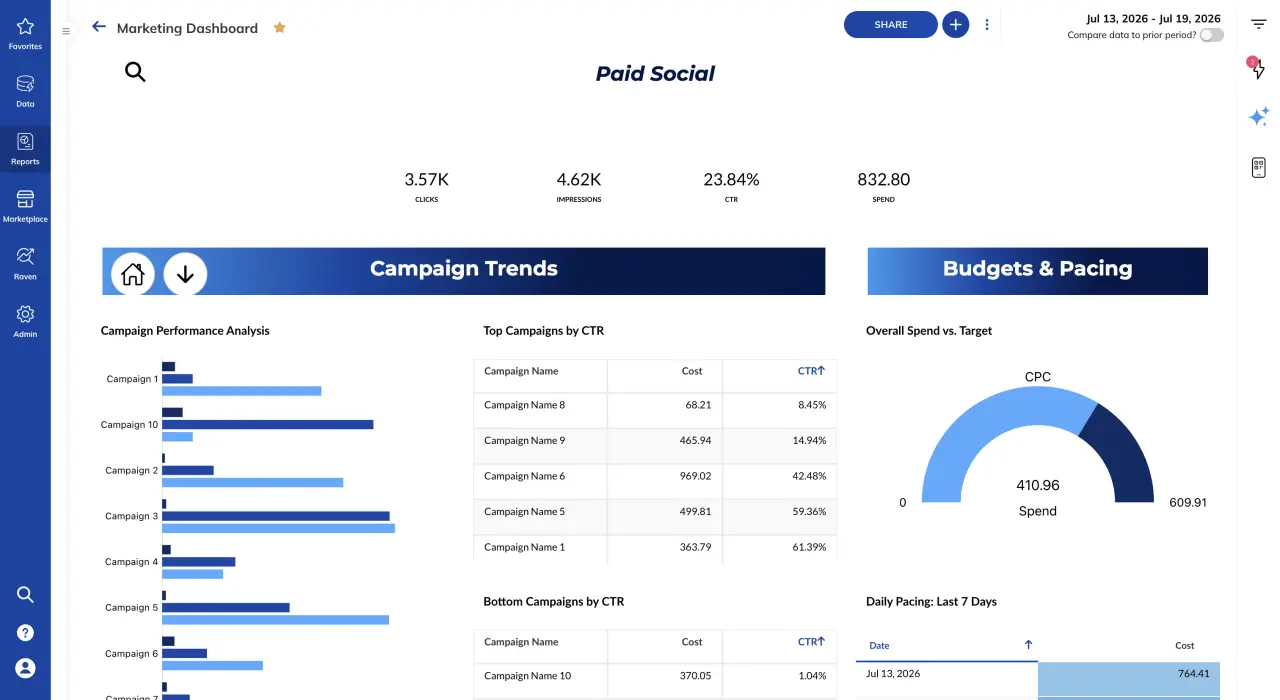
TapClicks Interactive Dashboards help marketing teams and agencies visualize performance within customizable reporting environments.
AI-Powered Marketing Intelligence
AI-powered marketing intelligence helps teams extract greater value from their marketing data by supporting analysis, identifying patterns, surfacing insights, and reducing manual investigation.
When supported by reliable, connected data, AI can help marketers answer complex performance questions, understand changes in campaign results, and identify opportunities for further investigation.
Rather than replacing marketing expertise, AI helps teams access and interpret information more efficiently so they can focus on strategic decision-making. TapClicks AI Insights Agents surface trends and anomalies across connected accounts, and Ask Your Dashboard answers plain-language questions about the data on screen.
Marketing Intelligence vs. Marketing Reporting vs. Marketing Analytics
Marketing reporting, marketing analytics, and marketing intelligence are closely related, but each serves a different purpose.
Marketing reporting communicates performance. Marketing analytics helps explain performance. Marketing intelligence combines data, analytics, reporting, and contextual insights to inform decisions.
| Capability | Marketing Reporting | Marketing Analytics | Marketing Intelligence |
|---|---|---|---|
| Primary Focus | Communicating results | Understanding performance | Informing decisions |
| Key Question | What happened? | Why did it happen? | What should we do next? |
| Typical Outputs | Reports and summaries | Trends and performance analysis | Insights and strategic recommendations |
| Common Tools | Reporting software | Analytics platforms | Unified intelligence platforms |
| Business Value | Visibility and communication | Measurement and optimization | Strategic decision-making |
A unified marketing intelligence platform brings these capabilities together, helping teams move from collecting information to understanding and acting on it. For a deeper look at connecting data sources, see our guide to unified marketing analytics.
What Are the Benefits of a Marketing Intelligence Platform?
For marketing agencies, enterprise teams, and media organizations, the value of marketing intelligence extends beyond simplifying reporting.
Centralized Marketing Data
Bring information from multiple marketing channels into a unified environment to reduce data fragmentation.
Greater Operational Efficiency
Reduce repetitive data collection, manual reporting, and administrative tasks through automation.
Cross-Channel Performance Visibility
Understand how marketing channels and campaigns contribute to broader business objectives.
Scalable Client Reporting
Create more consistent reporting processes across multiple clients, brands, campaigns, and business locations.
Faster Access to Insights
Use connected data, analytics, and AI-powered capabilities to identify trends and investigate performance changes.
More Informed Decision-Making
Give marketing teams and stakeholders the information they need to evaluate opportunities and guide strategy.
How to Choose the Right Marketing Intelligence Platform
When evaluating marketing intelligence platforms, organizations should consider how well the technology supports their current workflows, data requirements, and long-term growth.
Important capabilities to look for include:
- Extensive marketing data connectors and integration capabilities
- Automated, customizable marketing reporting
- Cross-channel analytics and performance measurement
- Interactive dashboards and data visualization
- AI-powered analysis and insight generation
- Data management and transformation capabilities
- White-label reporting and client management
- Scalability across accounts, teams, brands, and campaigns
- Data security and governance
The right marketing intelligence platform should do more than consolidate information. It should help organizations create a connected, scalable environment where marketing data can be transformed into meaningful business intelligence.
Turn Marketing Data Into Actionable Intelligence With TapClicks
Marketing intelligence starts with connected data. But bringing that data together is only the beginning.
TapClicks brings marketing data integration, analytics, automated reporting, interactive dashboards, and AI-powered capabilities together within a unified marketing intelligence platform.
From agencies managing hundreds of client accounts to enterprise teams monitoring complex, cross-channel campaigns, TapClicks helps organizations streamline marketing operations, understand performance, and turn data into actionable insights.
Frequently Asked Questions
Tap any question to expand the answer.
What is a marketing intelligence platform?
A marketing intelligence platform centralizes marketing data, reporting, analytics, dashboards, and insights within a unified environment. It helps organizations monitor performance, automate workflows, understand trends, and make more informed marketing decisions.
What is the difference between marketing intelligence and marketing analytics?
Marketing analytics focuses on measuring and analyzing marketing performance. Marketing intelligence takes a broader approach by combining connected data, analytics, reporting, and contextual insights to support strategic decision-making.
What is the difference between marketing intelligence and business intelligence?
Marketing intelligence focuses specifically on marketing data, campaigns, channels, audiences, and performance. Business intelligence covers a broader range of organizational data, including finance, operations, sales, and other business functions.
Can a marketing intelligence platform connect multiple marketing data sources?
Yes. Marketing intelligence platforms typically use data connectors and integrations to bring information from advertising platforms, CRM systems, website analytics tools, social media channels, and other marketing technologies into a centralized environment.
How does AI improve marketing intelligence?
AI can support marketing intelligence by analyzing large datasets, identifying patterns, surfacing performance changes, generating summaries, and helping marketers explore complex questions more efficiently.
What is a marketing intelligence platform for agencies?
A marketing intelligence platform for agencies helps centralize data from multiple clients and marketing channels, automate reporting, create customizable dashboards, analyze campaign performance, and scale marketing operations.
Does TapClicks offer marketing reporting, analytics, and dashboards in one platform?
Yes. TapClicks combines marketing data integration, automated reporting, cross-channel analytics, interactive dashboards, and AI-powered capabilities within a unified marketing intelligence platform.
Connect Your Marketing Data. Simplify Your Workflows. Make More Informed Decisions.
See how TapClicks brings data integration, reporting, dashboards, and AI-powered insights together in one marketing intelligence platform.