Marketing Analytics & AI
Marketing Attribution Models Explained: 6 Types and How AI Is Closing Their Biggest Gaps in 2026
Marketing attribution is the practice of assigning credit for a conversion to the specific marketing touchpoints — ads, emails, organic search, social posts — that influenced it. Most teams still default to last-click attribution because it's the easiest to set up, even though it's also the least accurate: single-touch models are known to misattribute conversions in more than 60% of multi-step buyer journeys (Omnibound, 2026).
That gap matters more in 2026 than it did a few years ago. B2B buyers now average 8–12 touchpoints before converting, third-party cookies no longer support reliable cross-site tracking, and roughly 89% of consumers research and buy across multiple devices (Digital Applied, 2026; Cometly, 2026). Marketers need a model — and increasingly, an AI system — that can reconstruct the journey from fragmented, first-party data.
This guide breaks down the six most common attribution models, where each one falls apart, and how AI-driven attribution is changing what “accurate” even means.
What Is Marketing Attribution?
Marketing attribution is a set of rules for assigning conversion credit across the touchpoints in a customer's path to purchase. The model you choose determines which channels look like they're working — and where your next dollar of budget goes.
For example, if a prospect sees a paid social ad, later clicks a retargeting ad, then converts from a branded search click, a last-click model gives 100% of the credit to search. A multi-touch model would split credit across all three. Neither answer is “wrong” — they're just optimized for different questions: last-click answers “what closed the deal,” while multi-touch answers “what built the pipeline.”
Why Attribution Got Harder in 2026
The old assumption behind attribution — that you can follow one user across the web with a cookie — no longer holds.
Third-party cookie deprecation has removed reliable cross-site tracking, shrinking the audiences advertisers can retarget and breaking the deterministic links attribution tools used to stitch journeys together (Ethyca, 2026). Cross-device behavior compounds the problem: with the large majority of consumers switching between phone, laptop, and tablet mid-journey, 20–40% of conversion paths now appear fragmented across what look like different, unrelated users (Cometly, 2026).
The practical result is that marketers are leaning harder on first-party data — but first-party cookies themselves often expire in 7–30 days, which isn't long enough to cover a multi-week B2B sales cycle. This is the environment multi-touch and AI-driven attribution models now have to operate in: incomplete, privacy-constrained, and increasingly modeled rather than directly observed.
6 Marketing Attribution Models Compared
Each model answers “who gets the credit” differently. Here's how the most common ones stack up.
| Model | How it assigns credit | Best for | Biggest weakness |
|---|---|---|---|
| First-touch | 100% to the first interaction | Measuring top-of-funnel/awareness channels | Ignores everything that closed the deal |
| Last-touch | 100% to the final interaction before conversion | Simple, fast reporting; short sales cycles | Overvalues bottom-funnel channels like branded search |
| Linear | Equal credit across every touchpoint | Balanced view when all touches matter similarly | Treats a passive impression the same as a demo request |
| Time-decay | More credit to touchpoints closer to conversion | Sales cycles where recency signals real intent | Still undervalues early awareness-building |
| U-shaped (position-based) | 40% first touch, 40% last touch, 20% middle | Crediting both discovery and closing | Arbitrary weighting; ignores journey specifics |
| Multi-touch / algorithmic (data-driven) | Credit weighted by each touchpoint's statistical contribution to conversion | Complex, multi-channel B2B journeys | Needs volume and clean data to model well — where AI comes in |
Multi-touch attribution (MTA) adoption has grown from roughly 31% of marketing teams in 2023 to about 47% in 2026, and 74% of high-growth companies now use some form of multi-touch model instead of single-touch rules (Omnibound, 2026). The catch: only about 18% of multi-touch attribution implementations are rated as highly accurate by the teams running them, because the model is only as good as the data feeding it (Omnibound, 2026).
Where Traditional Models Break Down
Rule-based models — first-touch, last-touch, linear, time-decay, U-shaped — all share the same flaw: the weighting is fixed in advance, not learned from what actually drove conversions. A U-shaped model gives 40% credit to the first touch whether that touch was a high-intent demo request or an accidental ad click.
Data-driven (algorithmic) multi-touch attribution fixes the weighting problem in theory, but it still depends on having enough clean, connected data across channels to model statistically. When your ad platforms, CRM, and analytics tools live in disconnected silos — the default state for most marketing teams — even a “data-driven” model ends up guessing. This is precisely the gap AI-driven attribution is built to close: not by inventing a smarter fixed rule, but by continuously re-weighting credit as it ingests more cross-channel data.
How AI Is Changing Marketing Attribution
Between 27% and 34% of marketers now use some form of AI-driven attribution, and organizations that pair AI-based multi-touch attribution with holdout testing see fidelity improve by roughly 22 points compared to purely deterministic models (Omnibound, 2026). The teams getting the most defensible numbers aren't relying on one model — they're running multi-touch attribution for day-to-day tactical decisions alongside marketing mix modeling (MMM) for strategic budget planning, then using AI to reconcile the two. MMM adoption alone has grown from 9% in 2023 to 26% in 2026 (Omnibound, 2026).
In practice, AI improves attribution in three ways:
- Pattern inference from incomplete data. Instead of requiring a deterministic cookie-based link between every touchpoint, machine learning models infer likely paths from partial, first-party signals — closing some of the gap left by cookie deprecation.
- Continuous re-weighting. Rather than a static U-shaped or linear rule, AI models update touchpoint weighting as new conversion data comes in, so credit reflects what's actually working this month, not a rule set a year ago.
- Anomaly and driver detection. AI can flag which specific channel, campaign, or creative shift changed the attribution picture — turning a monthly report into an ongoing diagnostic.
Organizations that have implemented multi-touch attribution well report meaningful downstream impact: average marketing ROI improvements around 18%, lead quality gains of 22%, sales cycle acceleration of 13%, and CAC reductions of 15% (Omnibound, 2026). Those gains come from better budget decisions — which are only possible once the attribution data underneath them is trustworthy.
5 Ways to Put AI-Driven Attribution to Work on Your Dashboards
Better attribution modeling doesn't help if the insights stay buried in a report nobody reads until month-end. Here's how AI features inside a marketing reporting platform like TapClicks turn attribution data into decisions your team actually acts on.
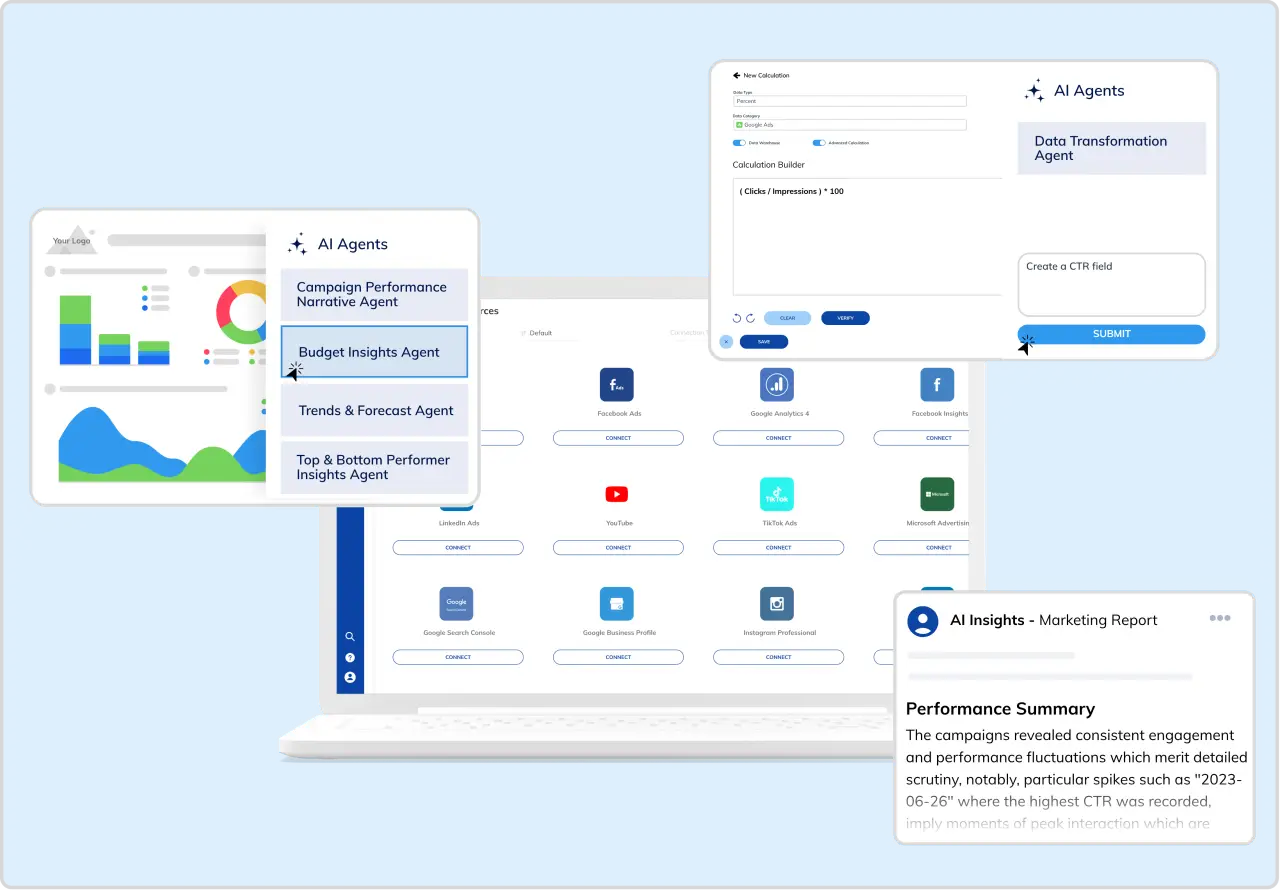
See TapClicks' AI tools — Ask Your Dashboard, AI Widget Creation, AI Insights Agents, and SmartSlides — in action.
- Ask your attribution data questions in plain language. Instead of building a new pivot table every time a stakeholder asks “which channel is actually driving pipeline,” Ask Your Dashboard lets you type the question directly and get an answer generated from the attribution and performance data already sitting in your dashboard.
- Auto-build attribution widgets instead of configuring them by hand. AI-powered widget creation lets you describe the visualization you want — say, “multi-touch credit by channel for the last 90 days” — and the platform selects the right widget type and data fields automatically, which matters when you're comparing six different attribution models side by side.
- Give AI business context so its recommendations are actually relevant. TapClicks AI Context lets teams feed in business-specific inputs — sales cycle length, target CAC, priority channels — so AI-generated attribution insights are weighted against your goals, not generic benchmarks.
- Let AI Insights Agents surface the attribution shifts that matter. Rather than manually scanning cross-channel reports for what changed, AI Insights Agents continuously analyze performance data and flag meaningful attribution and trend shifts as they happen, cutting the hours teams spend hunting for the story in the numbers.
- Turn attribution findings into stakeholder-ready narratives automatically. Once an attribution shift is identified, SmartSlides converts the underlying data into a presentation-ready deck with narrative and visuals built in — useful when you need to explain a budget reallocation to a client or the CMO without building slides from scratch.
For more on how this fits into broader marketing reporting, see our guides on AI in marketing analytics and marketing data visualization tools.
How to Choose the Right Attribution Model for Your Team
There's no universally “best” model — the right choice depends on sales cycle length, data maturity, and what decision the report needs to support.
- Low data volume or a short sales cycle: start with last-touch or time-decay. They're simple to implement and directionally useful when the buyer journey is short.
- Multi-channel campaigns with a longer B2B cycle: move to a position-based (U-shaped) or linear model as a bridge — more balanced than last-touch without requiring a data science team.
- Enough conversion volume and connected cross-channel data: invest in data-driven multi-touch attribution, paired with AI-based re-weighting so the model improves as new data comes in rather than staying static.
- Six- or seven-figure budget decisions: don't rely on MTA alone. Run marketing mix modeling in parallel and reconcile the two — this dual-model approach is what separates teams with defensible attribution from teams with a dashboard nobody trusts.
FAQ
What is the most accurate marketing attribution model?
There isn't a single “most accurate” model for every business — data-driven (algorithmic) multi-touch attribution is generally the most accurate when you have enough clean, cross-channel data to model statistically, but it requires more data infrastructure than rule-based models like linear or time-decay.
Is multi-touch attribution dead because of cookie deprecation?
No. Multi-touch attribution adoption actually grew from about 31% of teams in 2023 to roughly 47% in 2026, but the underlying data sources are shifting from third-party cookies to first-party and AI-modeled signals.
How does AI improve marketing attribution?
AI improves attribution by inferring likely conversion paths from incomplete first-party data, continuously re-weighting touchpoint credit as new data arrives, and flagging which specific channels or campaigns are driving changes in performance.
What's the difference between multi-touch attribution and marketing mix modeling?
Multi-touch attribution (MTA) assigns credit to individual, trackable touchpoints for tactical, campaign-level decisions, while marketing mix modeling (MMM) uses aggregate, channel-level data — including offline and untrackable spend — for strategic, higher-level budget planning. Many teams now run both and reconcile them with AI.
Can small marketing teams use AI-driven attribution without a data science team?
Yes — platforms with built-in AI Insights Agents and natural-language dashboard tools let smaller teams get AI-modeled attribution insights without building or maintaining custom statistical models in-house.
Sources:
- Marketing Attribution Statistics (2026): 54+ Data Points on Measurement Gaps, Model Adoption, and ROI Impact — Omnibound
- Marketing Attribution Statistics 2026: 140 Data Points — Digital Applied
- Third-Party Cookie Deprecation: The 2026 Guide — Ethyca
- Cookie Deprecation Impact on Ad Tracking: 2026 Guide — Cometly
- Cookie Deprecation Impact on Tracking: 2026 Guide — Cometly
- TapClicks AI Platform Brings New AI Marketing Intelligence Capabilities to Automate Performance Reporting — TapClicks